What 6,056 AI answers taught me about local and multilingual visibility
By Johnny Lagneau · Updated November 6, 2026Originally published October 27, 2026
Translated from French. Read the original
In short
- The big names fill the empty space: in the language where local businesses have published nothing, the AIs cite the big networks.
- The language of the website opens the door: in Brussels, Yago comes up in 52% of the answers in French and in 4% in English.
- Those who write for the other language take the place: Finest Consult comes up in 38% of the answers in English in Brussels.
- The word counts as much as the language, and directories count in 13% to 44% of the answers.
- Measurements of September 2026: 4 cities, 5 languages, 7 AIs, 6,056 answers.
Since September, I have asked the same 8 buyer questions to 7 AIs in four cities and five languages. Montréal in French and English. Brussels in French, Dutch and English. Luxembourg in French, German and English. Paris in French and English. Five professions, plus marketing agencies. In total, 6,056 answers (yes, I counted them).
I draw five findings from them. Here they are, with the numbers that show them.
| Business | City | Strong language | Weak language |
|---|---|---|---|
| Yago | Brussels | French: 52% (29 of 56) | English: 4% (2 of 56) |
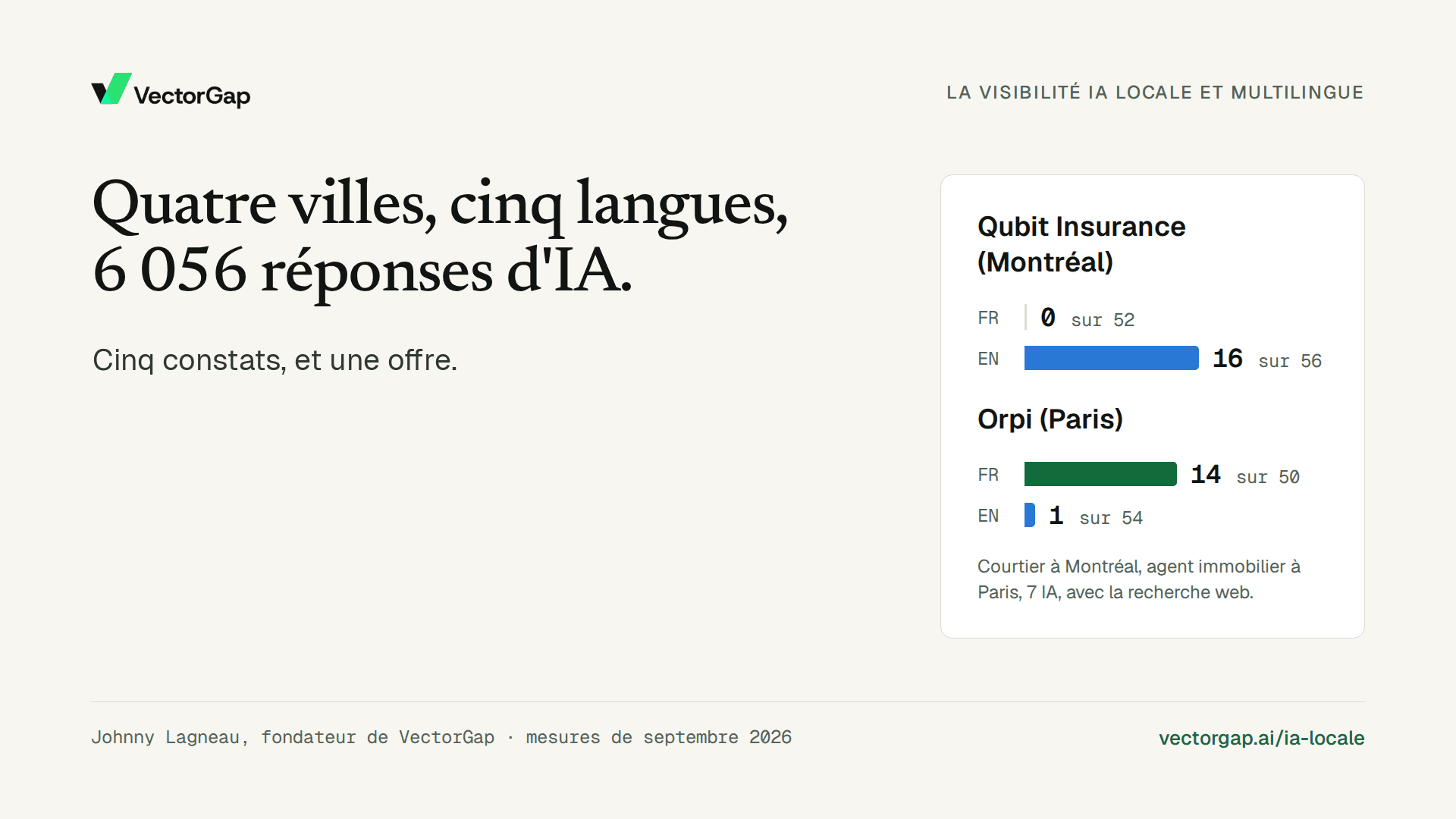
| Qubit Insurance | Montréal | English: 29% (16 of 56) | French: 0% |
| Orpi | Paris | French: 28% (14 of 50) | English: 2% (1 of 54) |
| Hayot Expertise | Paris | English: 28% (15 of 53) | French: 13% (7 of 55) |
| Web Tonic | Paris | English: 19% (10 of 54) | French: 0% |
VectorGap measurements; figures taken from the text of the article, no new figure.
1. The big names fill the empty space
Without web search, the AIs first name the big networks. Raymond Chabot Grant Thornton in Montréal, PwC in Luxembourg, Orpi and Century 21 in Paris, Publicis and Havas for agencies.
With web search, local businesses appear. But language by language. In the language where local businesses have published nothing, the big names come back. In Brussels, from what the AI has learned, a small business looking for an accountant in English is first sent to Deloitte: 39% of answers (22 of 56).
I don't think the big names are better. I think they are present everywhere. The AIs fill the gap with what they find.
2. The language of the website opens the door
This is the finding that comes back most often. Qubit Insurance, in Montréal, has a website in English: 29% of answers in English (16 of 56), none in French. Yago, in Brussels, has no website in English: 4% of answers in English (2 of 56), against 52% in French (29 of 56). Orpi, in Paris, has no website in English: 2% of answers in English (1 of 54), with web search.
That is the starting condition. Then content makes the difference. Finest Consult has a French website by default, and its articles for expats make it appear mostly in English. IBG has a website in four languages, and German is the language where it is cited most.
3. The AIs tie a language to a region
In Luxembourg, in German, the AIs name a real estate agency in Trier, in Germany. They also name a broker based in the far north of the country. In Brussels, in Dutch, they name an agency with Flemish roots that French almost ignores.
Several readers of the series wrote me the same thing: the sources the AIs consult change with the language. The AIs place each business in a language community. For a business, this means it does not have the same competitors in each language.
4. The word counts as much as the language
In Luxembourg, in German, Steuerberater
and Wirtschaftsprüfer und Steuerberater
do not give the same list. With the second, the Big Four come up much more. In Montréal, I asked the questions with expert-comptable
, while in Québec people rather say CPA (a reader from Montréal pointed it out to me, and he was right).
The customer does not search with the business's word. They search with their own.
5. Those who write for the other language take the place
Hayot Expertise, in Paris, has pages in English and an article for English speakers looking for an accountant: 28% of answers in English (15 of 53). Finest Consult, in Brussels, writes for expats: 38% of answers in English (21 of 56). Web Tonic publishes lists of Paris agencies in English: 19% of answers in English (10 of 54), none in French.
In every city, I saw small firms take a whole language. They wrote for the customers of that language.
And the directories
With web search, between 13% and 44% of answers cite a directory or a platform among their sources, depending on the city, the profession and the language. The AIs read the businesses' websites. They also read what others publish about them.
What I take from this for a local brand
One page per service and per language. A translated home page is not enough.
Write for the customers of each language: expats, cross-border workers, tourists, families who are arriving.
Keep your directory listings up to date in each language.
Test several words for your profession, in each language.
Measure language by language. A good result in one language says nothing about the other.
The places are there to take. In all four cities, I saw whole languages where local businesses had not done anything yet.
The test
I now want to show the before and after on real businesses. I am looking for three local businesses, or their agency, until 30 November.
I measure what the 7 AIs say about them in each language of their city. The business adds what it lacks in one language: a page, a listing, an article. I measure again 30 days later. That is my Snapshot, €250, remeasurement included. With their agreement, I publish the result, before and after.
Just ask me: through the Snapshot page, or by email at gap@vectorgap.ai.
To finish
If you work with businesses in a city where several languages are spoken, I would like your view.
In your city, which language do your clients still leave empty?